
Short answer: a garage door built for storms needs wind-rated panels, reinforced tracks, fresh springs, and a backup power source for the opener — and it needs all of that checked before the forecast turns, not after.
Most garage doors aren't built to take a direct hit from sustained high wind and flying debris. They're built to open and close smoothly, keep out rain, and look decent from the street. When a storm with real wind load rolls through South Florida, the door becomes one of the largest moving surfaces on the house, and if it gives way, wind pressure pushes into the garage and up against the roof structure from the inside. That's a different kind of failure than a leaky weatherstrip or a noisy roller, and it's worth understanding before storm season peaks.
Why Wind Pressure Goes After the Garage Door
A standard double garage door is one of the biggest unsupported panels in a typical home. Under sustained wind, that panel flexes. Under gusts and pressure changes, it can buckle inward or get sucked outward depending on which way the air is moving. Older doors, thin single-layer steel doors, and doors without horizontal bracing are the most likely to deform or pop off their tracks. Once a door fails and opens a gap, wind rushes into the garage and pushes upward against the roof decking from underneath — a mechanism that has lifted roofs off homes that otherwise would have ridden out the storm fine.
Salt air along the coast adds a second problem on top of wind: it accelerates rust on tracks, hinges, and spring coils, and humidity swings cause wood-core doors and door frames to swell and stick. A door that's already fighting corrosion or binding before the storm season even starts has less margin for the stress that's coming.
Signs Your Door Is More Vulnerable Than It Looks
- Visible rust on the track rails, hinge pins, or spring coils — weakens the metal right where it needs strength most.
- Panel flex you can see or feel when you push on the door from outside.
- Worn or cracked rollers that let the door wobble instead of running true in the track.
- A single-layer steel or non-reinforced door with no horizontal struts across the back.
- An opener with no battery backup, which means a power outage during the storm leaves the door however it was left — including stuck open.
- Swollen weatherstripping or a door that sticks partway, a sign of moisture intrusion that's also weakening the panel material over time.
The Pre-Storm Checklist
- Check the wind rating. Doors manufactured for wind-load regions carry a rating, usually printed on a label on the inside of the door. If you don't know your door's rating, that's worth finding out before storm season, not during a watch.
- Inspect and lubricate hardware. Hinges, rollers, and tracks should move freely. A light silicone-based lubricant on hinges and rollers helps fight the rust that salt air causes, and it reduces strain on the opener motor.
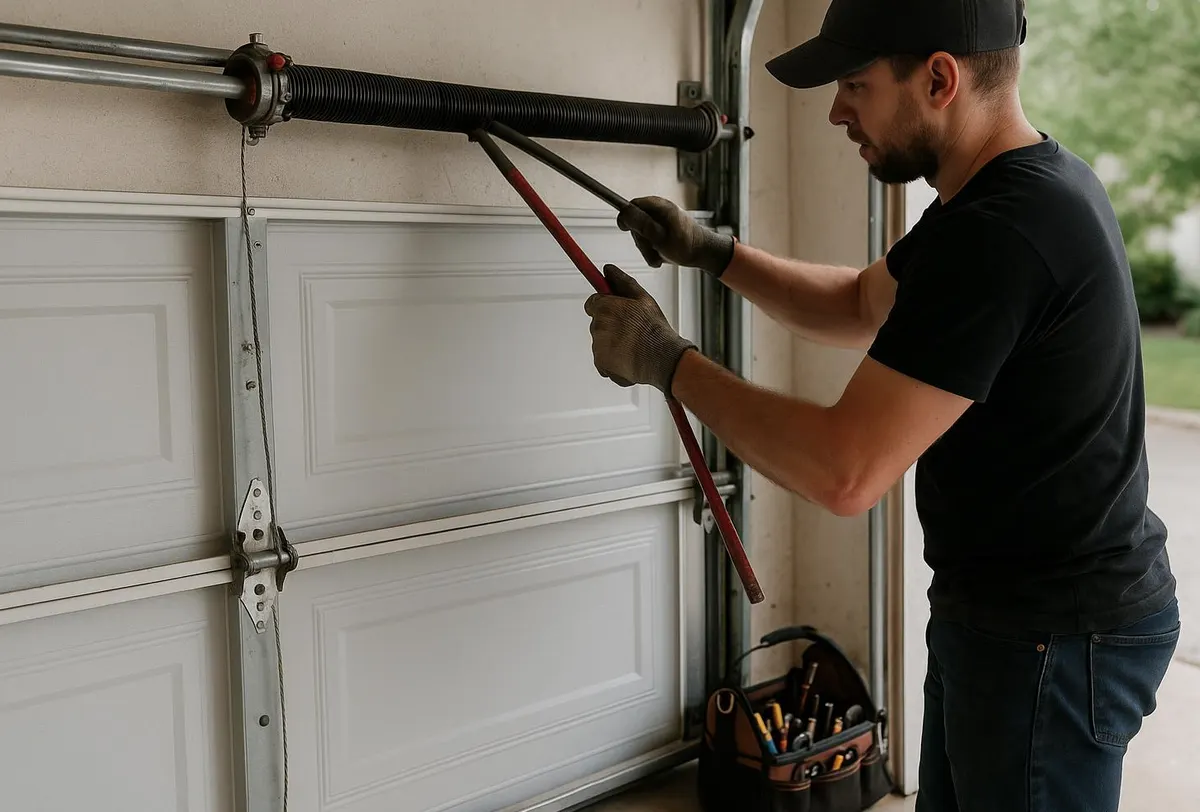
- Look at the springs. Torsion and extension springs lose tension over years of cycles, and a weakened spring puts more load on the door panel and opener during high-stress conditions. If a spring looks stretched, rusted, or uneven compared to its pair, it's due for replacement before, not during, storm season.
- Add or verify bracing. Horizontal reinforcement struts, sold as retrofit kits for many door models, stiffen the panel against wind pressure. This is one of the more cost-effective upgrades available — a few hundred dollars in parts and labor versus a full door replacement.
- Test the opener's backup power. If your opener has a battery backup, make sure it actually holds charge. If it doesn't have one, it's worth adding before outages become routine for the season.
- Clear the tracks of debris. Afternoon downpours wash dirt and leaf litter into the track channel, and a door fighting debris during a storm is a door more likely to jump the track.
- Know your manual release. If the opener loses power mid-storm, you should be able to disengage it and secure the door manually without searching for instructions in the dark.
The Trade-Off Worth Knowing
Bracing kits and hardware tune-ups are the budget-friendly path and genuinely help, but they don't turn a non-rated door into a wind-rated one. If your door is older, already showing panel damage, or you've never confirmed its rating, a full replacement with a wind-rated, impact-resistant door is the more permanent fix. It costs more upfront — impact-rated residential garage doors typically run from the low thousands into the mid-thousands depending on size and material, as a national range — but it removes the guesswork every storm season going forward.
When to Call Pompano Beach Garage Door Pro
If you're hearing grinding, seeing rust on the track or spring coils, noticing the door sag or flex, or you simply don't know whether your door meets current wind-load standards, that's the point to call in before a storm is on the radar. Pompano Beach Garage Door Pro handles garage door maintenance to catch rust, worn rollers, and misalignment early, and spring replacement when tension has dropped below safe levels. We'll also tell you straight whether bracing is enough or whether it's time to talk upgrade.
Don't wait for a storm watch to find out your garage door can't hold. Call Pompano Beach Garage Door Pro today and get your door storm-ready before the next system moves through Pompano Beach, FL.